Got to East Tilbury post childcare in time to join the group of birders who had just seen the KP fly upriver. Wandered upriver to try and track it down and, while picking up 4 Curlew Sand plus a bunch of usuals (2 godwit spp, RPs, Dunlin, Avocet, etc) couldn't relocate the plover. Spent quite a few hours here but eventually gave up as the tide moved further and further out and headed off to Vange where a Red necked Phalarope had been around for the last few days. The place is a bit of a bugger to find but it's a brilliant site. The easiest thing to do is park in Wat Tyler in the first car park through the gates. head back up the road over the level crossing and turn left down a footpath opposite the station car park (and alongside White's Aggregates). turn left when you get to the start of the overpass, back over the railway line then go right until you can see the scrape ahead. There's a path that runs round it with occasional viewing mounds. The initial scan turned up an imm Spoonbill, 4 Dunlin an ad Little Stint, 3 Greenshank, several Green Sand, 11-12 Spotshank (including 10 all together), but no sign of the phalarope. Moving onto the next viewing mound and scanning around another group of birders turn up who've been watching it from the other side of the scrape - looks like it's in the north east corner. Another birder on the mound quickly picks it up - a really smart juv RN Phalarope swimming around - bit distant but the usual unidentifiable digiscope shots possible. (TBC)
Sunday, 29 August 2010
Thames Waderfest
The plan for today is have a pootle around a number of Thames sites to pick up a bunch of waders for the year. On offer are Curlew Sand, Little Stint, Wood Sand, a Pec, Red necked Phalarope and a KP. Throw in the usual stuff and we could be talking about 20 species of waders in a day (and six year ticks). Since I spent my formative birding years next to the Thames and weaned by Redshanks I do have a soft spot for waders. While my British List is pretty meagre, waders do feature quite strongly and, while missing quite a few goodies (no Short billed runt Curlew for instance) it has its highlights (courser on the local patch, hat tricks of pratincoles and lapwings, all the peeps except Long toed, PGP when it wasn't a trash bird, Sharp tailed and Stilt Sands and one of the few real blockers on my list: Little Whimbrel Curlew.
Got to East Tilbury post childcare in time to join the group of birders who had just seen the KP fly upriver. Wandered upriver to try and track it down and, while picking up 4 Curlew Sand plus a bunch of usuals (2 godwit spp, RPs, Dunlin, Avocet, etc) couldn't relocate the plover. Spent quite a few hours here but eventually gave up as the tide moved further and further out and headed off to Vange where a Red necked Phalarope had been around for the last few days. The place is a bit of a bugger to find but it's a brilliant site. The easiest thing to do is park in Wat Tyler in the first car park through the gates. head back up the road over the level crossing and turn left down a footpath opposite the station car park (and alongside White's Aggregates). turn left when you get to the start of the overpass, back over the railway line then go right until you can see the scrape ahead. There's a path that runs round it with occasional viewing mounds. The initial scan turned up an imm Spoonbill, 4 Dunlin an ad Little Stint, 3 Greenshank, several Green Sand, 11-12 Spotshank (including 10 all together), but no sign of the phalarope. Moving onto the next viewing mound and scanning around another group of birders turn up who've been watching it from the other side of the scrape - looks like it's in the north east corner. Another birder on the mound quickly picks it up - a really smart juv RN Phalarope swimming around - bit distant but the usual unidentifiable digiscope shots possible. (TBC)
Got to East Tilbury post childcare in time to join the group of birders who had just seen the KP fly upriver. Wandered upriver to try and track it down and, while picking up 4 Curlew Sand plus a bunch of usuals (2 godwit spp, RPs, Dunlin, Avocet, etc) couldn't relocate the plover. Spent quite a few hours here but eventually gave up as the tide moved further and further out and headed off to Vange where a Red necked Phalarope had been around for the last few days. The place is a bit of a bugger to find but it's a brilliant site. The easiest thing to do is park in Wat Tyler in the first car park through the gates. head back up the road over the level crossing and turn left down a footpath opposite the station car park (and alongside White's Aggregates). turn left when you get to the start of the overpass, back over the railway line then go right until you can see the scrape ahead. There's a path that runs round it with occasional viewing mounds. The initial scan turned up an imm Spoonbill, 4 Dunlin an ad Little Stint, 3 Greenshank, several Green Sand, 11-12 Spotshank (including 10 all together), but no sign of the phalarope. Moving onto the next viewing mound and scanning around another group of birders turn up who've been watching it from the other side of the scrape - looks like it's in the north east corner. Another birder on the mound quickly picks it up - a really smart juv RN Phalarope swimming around - bit distant but the usual unidentifiable digiscope shots possible. (TBC)

Sunday, 15 August 2010
Barnes chicks and kills
First visit to the London Wetland Centre for a while - a couple of hours in the late afternoon when the place has already been burnt up by the local families thrashing the bushes for rare acros. Despite this, while getting out of the car had a Sparrowhawk being mobbed by a Common Tern over the car park. Plenty of chicks around with 2 broods of Mute Swans, at least 4 of Tufted, 1 juv GC Grebe still associating with its parents, a Little Grebe (with just one chick), loads of Coot and Moorhen juvs around,
Also on site c50 Teal, c15 Shoveler, 4 Common Tern, 4 gull spp, still around 20 Sand Martin, Peregine with a kill on the hospital. Passerines really thin on the ground (see acro thrashing above).

Also tried an experiment with the new(ish) camera looking at the difference between using converters and cropping more. Overall I think the results are, err, inconclusive. These are the two shots at 400mm and 560mm (ie a 400mm lens with a 1.4 TC attached). Both are compressed down to around 300kb. Same bird at approx the same distance (400mm shots probably slightly closer).


Cropping both the shots to around the same size gives the following two pics (400mm first then 560mm).


Also on site c50 Teal, c15 Shoveler, 4 Common Tern, 4 gull spp, still around 20 Sand Martin, Peregine with a kill on the hospital. Passerines really thin on the ground (see acro thrashing above).

Also tried an experiment with the new(ish) camera looking at the difference between using converters and cropping more. Overall I think the results are, err, inconclusive. These are the two shots at 400mm and 560mm (ie a 400mm lens with a 1.4 TC attached). Both are compressed down to around 300kb. Same bird at approx the same distance (400mm shots probably slightly closer).

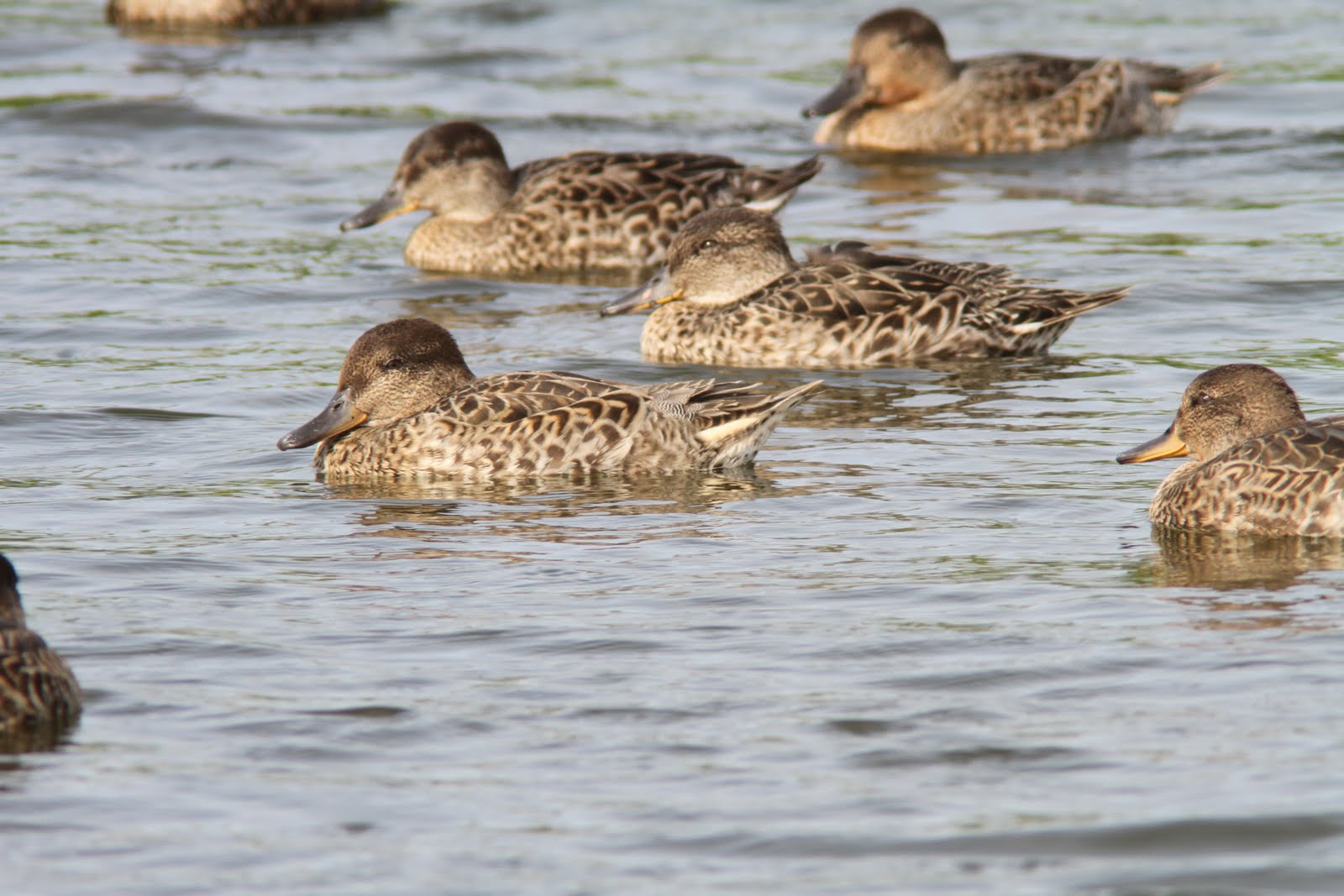
Cropping both the shots to around the same size gives the following two pics (400mm first then 560mm).


For fellow obsessives these are taken with a Canon 7D, Canon 400mm f5.6 lens with or without mk II 1.4x extender. 400mm shot at f5.6 and 1/1000, 560mm at f8 and 1/160.
Friday, 13 August 2010
Wandsworth Common Tufty Club
The Tufties on the Common tend to have a pretty mixed breeding record. There are usually 1-2 broods every year (although occasionally none). This year looks like a fairly average year with two broods, but one of them has 8-9 ducklings in. The question over eight or nine is because there's a female Tufted with 8 ducklings following but there's another ducking of the same age bobbing around in the middle of the pond being ignored. The other brood is made up of two older birds. Also around 8 other Tufted on the ponds. Also on or around the ponds are 1 Egyptian Goose, 8-10 Moorhen including at least 2 juvs.
In The Scope there is at least one juv Robin, a Chiffchaff calling (I assume they've bred here again this year, but haven't seen a juv yet); Sparrowhawk.
In The Scope there is at least one juv Robin, a Chiffchaff calling (I assume they've bred here again this year, but haven't seen a juv yet); Sparrowhawk.
Sunday, 25 July 2010
Wandle: 6-0 or 7-2?
Off to the Wandle today with the boys and high hopes. The reason for the high hopes is the chance of getting 7 species of gull and 2 patch ticks. I'm confident of picking up the usual gulls (GBB, LBB, Herring, BH) and also have a chance of Common Gull (already picked up on the patch by Mr Thing two weeks ago). There's also the chance of picking up the ad Yellow legged Gull that's been loafing around for a while and that I originally saw about 3 weeks ago and which has been seen since. Even more majorly there's the chance of a Med Gull that was seen over the Wetland Centre a couple of days ago (as the gull flies only a mile or so from the patch boundary). Clean up on those and it would mean a massive 7 gull species day. The Med would also be a patch tick, as would Redshanks seen both just outside the patch (by Nathalie) and, even more tantalisingly, actually on patch mud just 2 days ago. So the target is 7 gulls spp and 2 patch ticks.
At the Wandle mouth it looks like a few of the local species have had a good breeding season with four juvenile Blackbirds, at least 3 juv Greenfinches and a single Goldfinch in the immediate area.


At the Wandle mouth it looks like a few of the local species have had a good breeding season with four juvenile Blackbirds, at least 3 juv Greenfinches and a single Goldfinch in the immediate area.


A couple of Mute Swans on the Wandle Delta

One of the local Greylags with Canuck.


Herring Gull landing:


Male Sparrowhawk over the Thames

The Yellow legged Gull of a few weeks back is still around - a bit closer this time.

Monday, 19 July 2010
Wandle terns slow
Fairly slow on the patch with a Common Tern fishing over the Thames.

A GBB in flight.

Wandle Delta had 4 female Tufted, around a dozen Mallard including 3 half-grown chicks (from two different broods)
Further along the Thames up to Wandsworth Park there were around 50 Mallard, c40 Black headed Gulls including 2 juveniles and 1 bird moulting into 1st winter, 30+ Canadas and a Grey Wag flying upriver. No sign of the YLG from two weeks ago.

A GBB in flight.

Wandle Delta had 4 female Tufted, around a dozen Mallard including 3 half-grown chicks (from two different broods)
Further along the Thames up to Wandsworth Park there were around 50 Mallard, c40 Black headed Gulls including 2 juveniles and 1 bird moulting into 1st winter, 30+ Canadas and a Grey Wag flying upriver. No sign of the YLG from two weeks ago.
Saturday, 17 July 2010
Cornwall (11-17th July)
Family holiday in Cornwall staying right on the sand on Porthmeor in St Ives - just down from St Ives Tate. Right at the start of the seawatch season and family stuff precluded any real birding, but just setting up a scope in the sitting room managed to pick up daily totals of 10+ Kittiwake, 15+ Shag, 200+ Manx Shear, 10+ Gannet, 3-4 local Rock Pipit including a couple of recently fledged juvs and a few Common Terns. Also had 4 Guillemots on Sunday.
Saturday, 10 July 2010
Slimbridge slips one in
Bizarrely it looks like the White tailed Plover Lapwing has bought a guide to the UK's RSPB and WWT reserves and is touring all of them. Yesterday it was Rainham, today it's Slimbridge. Tomorrow maybe it's the London Wetland Centre...... It being in Slimbridge presents an interesting problem. Today's the first day of my family holiday, to Cornwall. The usual debate about A303 v M4/M5 now looks a bit more one sided, especially if it looks more like M4-M5 north-Slimbridge-M5 south. Downsides are that my partner's bored shitless/ borderline hostile not remotely interested in birding. I'm driving so it's just possible I could get lost, north, south, easily done.
As it turns out tolerant partner is up for a stop off to feed the kids and break up the driving, although with time limited viewing privileges. We'll talk about what happens if it doesn't show after we're there......
As it happens,speed walked quickly strolled to Zeiss Hide and scanned - to see this.


Or actually an in-focus version of these dodgy camera handheld to scope shots. Really stunning bird - long legs and a hint of a crest lying over the nape.
As it turns out tolerant partner is up for a stop off to feed the kids and break up the driving, although with time limited viewing privileges. We'll talk about what happens if it doesn't show after we're there......
As it happens,


Subscribe to:
Posts (Atom)