
Tuesday, 29 March 2011
Blue winged Teal
Visited friends in Bristol at the weekend and couldn't resist a trip Welsh side to the Blue winged Teal a Sandy Water Park. Nice patch - as well as the Teal also picked up Little Gull and Kingfisher. The local woods seemed to have picked up decent numbers of migrants with both Chiffchaff and Willow Warbler singing.


Friday, 25 March 2011
OK, I did - Weak-willed Treecreeper at Landguard
Since I suspected I was going to cave and see the Treecreeper anyway I decided to go on Friday rather than Saturday since the compound can be difficult to see into when it gets crowded.
This was an after work trip, when I got there a little after 3 there were only a dozen people. The bird showed within a few minutes (and only for a few minutes) on the side of one of the Holm Oaks. We then lost it for a bit before it reappeared feeding low down on small branches. Although you wouldn't know it from the photos below it often showed very well, frequently feeding low down in small scrubby bushes.
Poor light and too many branches for the autofocus (and my lack of ability) resulted in these shots:

Sunday, 20 March 2011
Wandsworth Common - Collared Dove
Sunday: Collared Dove on the north half of Wandsworth Common today. I occasionally see these at the bottom of the Common but very rarely this far up. Possibly a local range expansion? Or maybe just a random flyover.
Saturday, 19 March 2011
Barnes Brambling
Saturday: a bright sunny day raised hopes of a few migrants in at Barnes (maybe a Chiffy, Sand Martin or LRP). Redshanks are fairly new in - six birds across the site. This one from Dulverton Hide.

Also from Dulverton had a burst of song from a Cetti's and caught a flash of brown that looked Cetti's-like so just picked up the camera reeled off a few shots.


Had great views of the Water Pipit from the WWT Hide feeding on the edge of one of the Main Lake islands. Was able to get a few shots and also a video.


This shot at 800mm with the 2x converter.

In the hide one of the regulars gave me a heads up to a Brambling showing at the WWT Feeders - this would be a 'deck tick'. I've heard a couple overhead in autumn but never one on the deck.


Also on or around the feeders: 3 Reed Bunting (2f, 1m) and a GS Woodpecker. A walk around the Sheltered Lagoon turned up a single Chiffchaff - not calling or singing but presumably fresh in since I've not seen any Chiffies here since the snow.


From the Peacock Hide were 3 Dunlin still in winter plumage, the Water Pipit dropped in to feed on the islands, several of the Lapwings were displaying, another 5+ Redshank (so at least 6 in site), still around 30 Wigeon present and a total of 10 Snipe on site.


Sunday, 30 January 2011
Canon teleconverter experiments at Barnes
Cold day (1-2C) with cold NE winds hitting even central London, but not enough to kick off any bird movements at Barnes. The Shelduck is still present (as, apparently, is the Scaup although I missed it today).
I also tried out my new Canon 2x teleconverter for the camera (a Canon 7D) using it for both close targets like this Mallard. This bird was fairly close and shows up rather soft.

And more distant ones like these Peregrines (on Charing Cross Hospital taken from the WWF hide). These shots were taken with both 2x (the first photo) and then stacked 2x and 1.4x converters (the second). The stacked teleconverters combined with the 400mm lens (the f5.6 prime) add up to a focal length of 1120mm (sort of equivalent to a magnification of 22x). Basically I think the birds were just too far away for this to be any kind of useful test, but shots are included to give some idea of the difference in reach. While its hard to see on the small grey dots, the size difference between the two birds (female on the left) is immense. The birds are the small dots on the third railing down from the top and the second and sixth 'columns' from the left of the right hanbd (protruding part) of the buidling. The Peregrines perch here quite a lot, usually either on these railings or on the top of the white verticals.


A massive crop from the photo of the female with stacked teleconverters. This is, obviously, pretty rubbish, but, with a rough calculation using Google maps this is only slightly under a mile away (about 5,000 feet).

The day was pretty dull with poor light so shutter speeds were rock bottom which really didn't help photo quality.
The Siskin flock is still on site, around 14 birds around the back of the Sheltered Lagoon, but missing the Lesser Redpolls previously with the flock.
A few Snipe were also present, although fewer than at the start of the winter period. Jack Snipe seem especially thin on the ground this year. The water levels have been very high at Barnes for some time - whenever this happens the numbers of Snipe always seem to plummet. One of the few birds showing today below (taken with the 400mm and 2x converter).

Great crested Grebes seem to be in a mix of plumages ranging from some in full summer and others barely out of winter plumage - one pair were diplaying together were made up of a 'summer' and a 'winter' bird.
Thursday, 27 January 2011
Waxwing duck broken
Had a cheeky trip out from the office today. I was scanning through the news services while I was on the phone and found that there was a flock of Waxwings about 10 minutes walk from the office. I'd dipped on another flock near the office about 10 days ago and had failed on another 3-4 attempts during the current invasion. I was beginning to think that I'd be the only birder in the country not to pick up any Waxwings despite the thousands of birds currenlty in the country.
I wandered round St John's Square peering into berry trees with no success then looked up to see tv aerials covered in Waxwings. All the following shots taken with a rubbish phone camera - of all the hundreds of Waxwing photos currently on the web, these may well be the worst.


Looking for more berry trees I saw another birder had one staked out with a camera and went over to join him. The Waxwings did a few flights round the tree but were a little nervous of landing as the street was pretty busy with a constant stream of people walking past their favoured tree. At one point they landed in the small tree, grabbed a few berries each and flew off again, returning to the TV aerials.
Monday, 24 January 2011
Cheeky work twitch
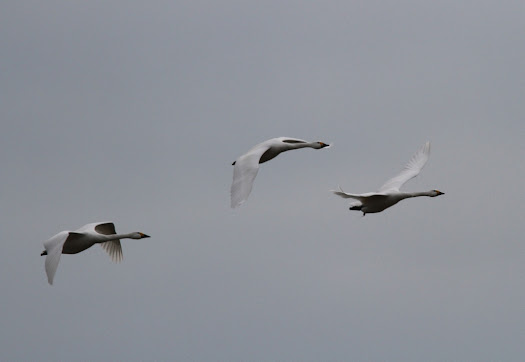
I had a meeting in Staines today which was temptingly close to a herd of Bewick's found at Harmondsworth just north of Heathrow Airport. After the meeting I drove round to where they'd been reported and, driving slowly and peering through a hedge saw what looked like a group of swans in a field with a bunch of gulls. Lept out of the car in my suit and scanned the field - 16 Bewick's Swans including 3 juveniles. I dived back into the car to change into jeans and put some more jumpers on, grab scope and camera, etc. This took about five minutes and, emerging from the car, saw the flock in flight clearing the hedge in front of me - managed to get off a few shots. I'd foolishly left my 1.4x converter on the lens so had to focus manually since there wasn't time to change it.




Briefly stopped off at Staines Reservoir to check for the Great Northern Divers seen yesterday but not sign on a fairly quiet trip. Highlight were 35-40 Goldeneye, good numbers of Wigeon and Shoveler and a flock of 30 or so Fieldfare on the west bank.
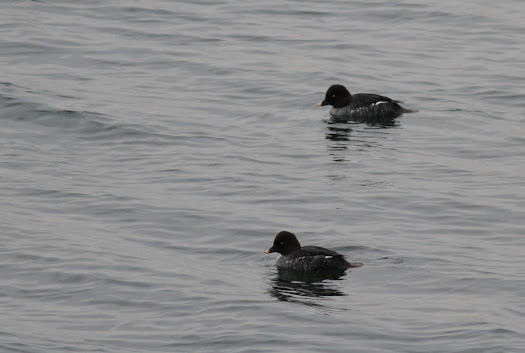


Briefly stopped off at Staines Reservoir to check for the Great Northern Divers seen yesterday but not sign on a fairly quiet trip. Highlight were 35-40 Goldeneye, good numbers of Wigeon and Shoveler and a flock of 30 or so Fieldfare on the west bank.


Subscribe to:
Posts (Atom)